
Arrest Records in Maricopa County
Maricopa County arrest records do not come from one county database. The Maricopa County Sheriff's Office makes arrests in unincorporated and contract areas and operates the county jail system. Phoenix, Mesa, Chandler, Scottsdale, Tempe, Glendale, campus police, transit police, and Arizona DPS can each create their own incident or arrest report. If an arrested person is delivered to an MCSO jail, the sheriff then creates a separate booking and custody record. The report and booking may describe the same event, but they serve different purposes and have different custodians.
A third record can begin after the arrest. A prosecutor may file a complaint, information, or indictment, and the receiving court then records hearings, charges, release terms, and disposition. Felony cases generally move through the Superior Court of Arizona in Maricopa County. City and lower-level matters may stay in a municipal or justice court. Arizona DPS may also receive fingerprint and disposition data for the Central State Repository under A.R.S. § 41-1750. That repository is not a public name-search service.
Maricopa County Arrest Agency Split
The first common mistake is asking the jail for a police narrative. MCSO can confirm the booking, custody status, facility, and charge-at-booking information it holds. The department that made the arrest normally keeps the incident report, dispatch material, body-camera records, and other police evidence. The court clerk keeps the case file after charges are filed. A complete Maricopa County arrest search may require requests to all three offices.
The Maricopa County public records portal is the broad county request route. Select the department and state whether the request is commercial or non-commercial. For MCSO jail help, call 602-876-0322. For a city arrest, start with that city's police records unit. Arizona Public Records Law, including A.R.S. § 39-121 and § 39-121.01, governs inspection and copy requests, but protected details may be redacted.
Maricopa County Sheriff's Office Records
County public-record requests route through the official county portal. MCSO jail and inmate help is available by phone.
Jail information: 602-876-0322
Main MCSO address: 550 W. Jackson Street, Phoenix, AZ 85003
Maricopa County Arrest Lookups
Begin with the newest official source, then work toward records that take more time to appear. Keep the full name, date of birth, approximate arrest date, arresting agency, report number, booking number, and case number when known. These identifiers reduce false matches and help a clerk distinguish a police event from a jail admission or court case.
- Check the MCSO Daily Jail Population Report for current county custody. Its alpha list is a roster, not a conviction search.
- Call MCSO jail information at 602-876-0322 when the roster does not answer a custody, facility, or release question.
- Request the arrest or incident report from the agency that made the arrest. Use its online form, mail route, phone line, or records counter as available.
- Search Superior Court, Justice Court, or the correct municipal court after a prosecutor files charges. A booking may appear before the court case.
- Use the Maricopa County public records portal for county-held material that is not available through a live roster.
- For review of your own statewide repository record, use the Arizona DPS Public Services Portal or call the Central State Repository Section at 602-223-2000, Option 2, then Option 3. Fingerprints are required for record review.
- After a sentence sends a person to state prison, switch from MCSO to the ADCRR Inmate Data Search.
Note: An empty jail roster result does not show that no arrest occurred, because released people may no longer appear.
Phoenix Arrest Record Channels
Phoenix Police uses its Public Records portal to accept requests, display submitted requests, and show invoices. Assistance is available at 602-534-1127, and the Public Records and Services Unit is at 100 W. Washington Street, Phoenix, AZ 85003. A Phoenix police report remains a city record even when MCSO handled the jail booking. If charges were filed, the later case belongs to Phoenix Municipal Court or Maricopa County Superior Court based on jurisdiction.
The official portal is visible in the Phoenix Police source captured for the Maricopa County arrest research.
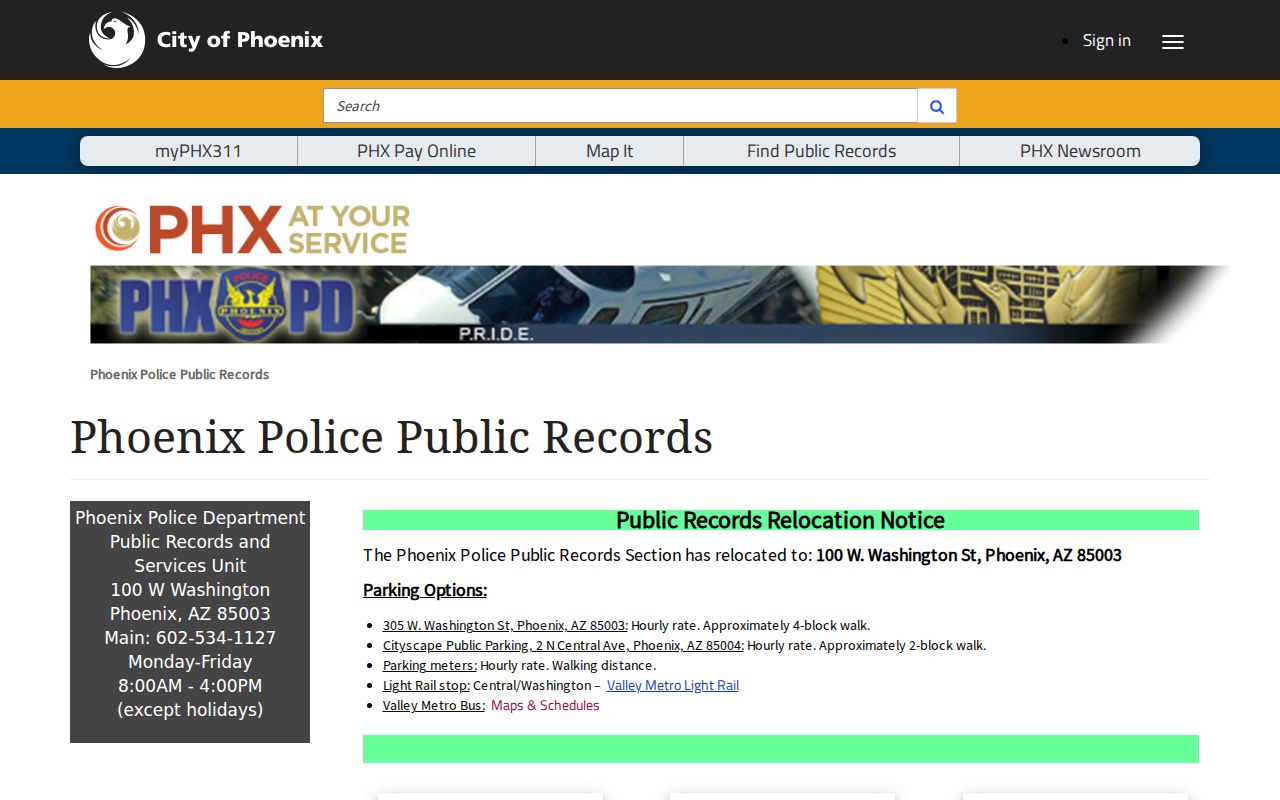
The request dashboard helps keep a police-record request separate from the MCSO booking and court-record checks.
Phoenix publishes concrete copy charges through its records FAQ. Incident and traffic crash reports cost $0.24 per page. On-body camera audio or video, photos, recorded interviews, and surveillance video are each listed at $4. A 911 recording is $16.50, while calls for service and crime statistics have no charge. The page also explains a local Phoenix Police letter of clearance. That letter checks Phoenix Police arrest and criminal records only; it is not a statewide Arizona rap sheet.
The Phoenix Police fee source shows how the city classifies common Maricopa County arrest record products.
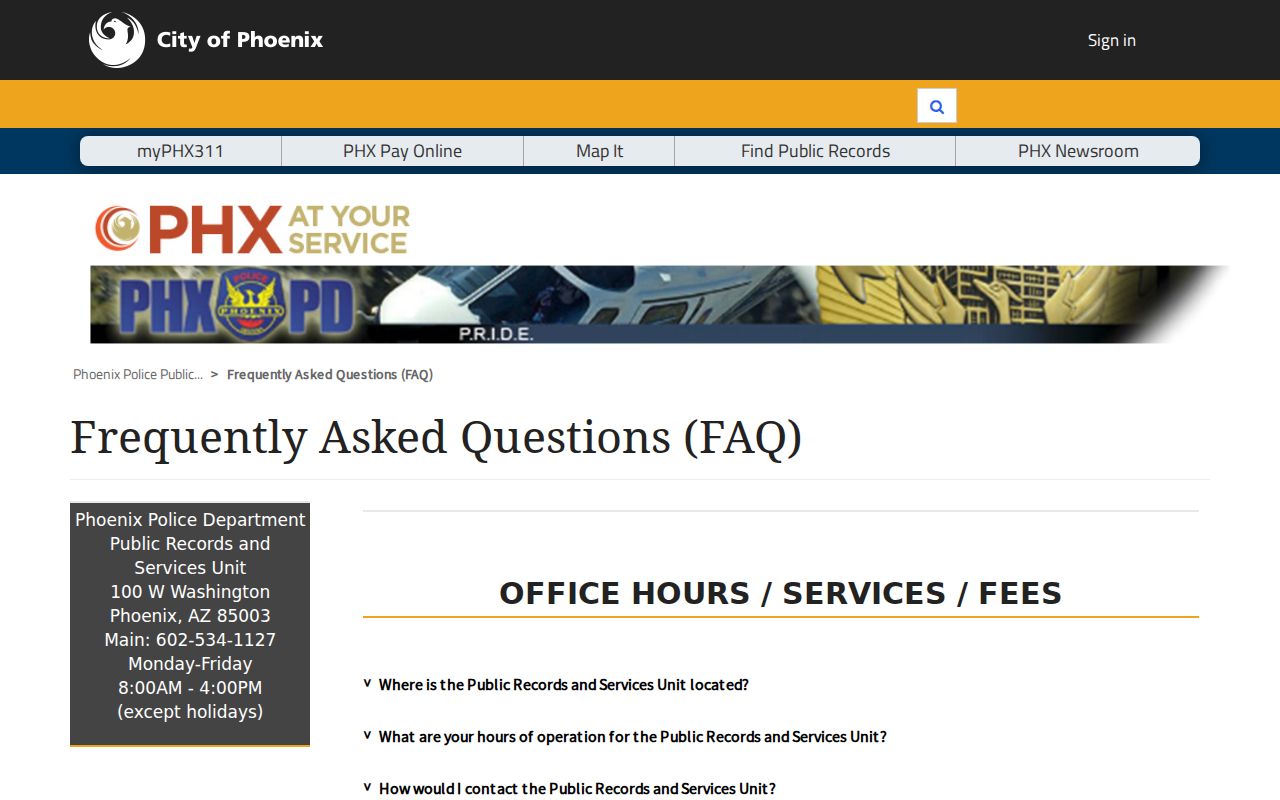
Knowing the product name before filing can prevent a request for a police report from being mistaken for a clearance letter.
Arrest Records: What They Contain
A Maricopa County arrest file can combine identity, police, jail, and court identifiers, but no one public display is guaranteed to show them all. The police report can include the event narrative and report number. The MCSO list focuses on custody. Court and DPS data may later add case or disposition information. Treat each field as a pointer to its source, not as proof that every later charge or outcome stayed the same.
| Incident or Report Number | The arresting agency's identifier for its police report and related material. |
|---|---|
| Arrest Date and Agency | When the custody event began and which law-enforcement agency made the arrest. |
| Booking Number | The MCSO jail identifier used to distinguish one intake from another. |
| Booking and Arrival Dates | When jail intake and arrival were recorded; these may differ from the arrest time. |
| Status and Release Date | Current custody status and an expected release date when the roster supplies one. |
| Charges at Booking | Allegations recorded at intake, which may differ from charges later filed by a prosecutor. |
| Fingerprint Control Data | The process control number and fingerprints used for eligible reporting to Arizona DPS. |
| Court and Bond Data | A court case number, release conditions, or bond information when later linked to the event. |
| Police Narrative | The arresting agency's account, which may be redacted for active cases, victims, juveniles, or protected data. |
Mesa and Chandler Arrest Requests
Mesa Police places reports and related records with its Criminal Justice Information Division. The Mesa Police Records Center offers public-record requests, account access, subpoena requests, and vehicle-release requests. A person tracing a Mesa arrest should get the report from Mesa CJID, check MCSO for county booking, and use Mesa Municipal Court or Superior Court for the filed case.
Chandler offers both records requests and official open data. Its Police Records Unit page covers police report requests and clearance letters. A clearance letter costs $10. In person, it requires government photo identification and may be issued the same day. Mail requests require the form, a notarized ID copy, and a $10 check sent to Chandler Police Department, Mail Stop 303, PO Box 4008, Chandler, AZ 85244-4008.
The Chandler source captured for Maricopa County arrest research shows the police report and clearance request route.
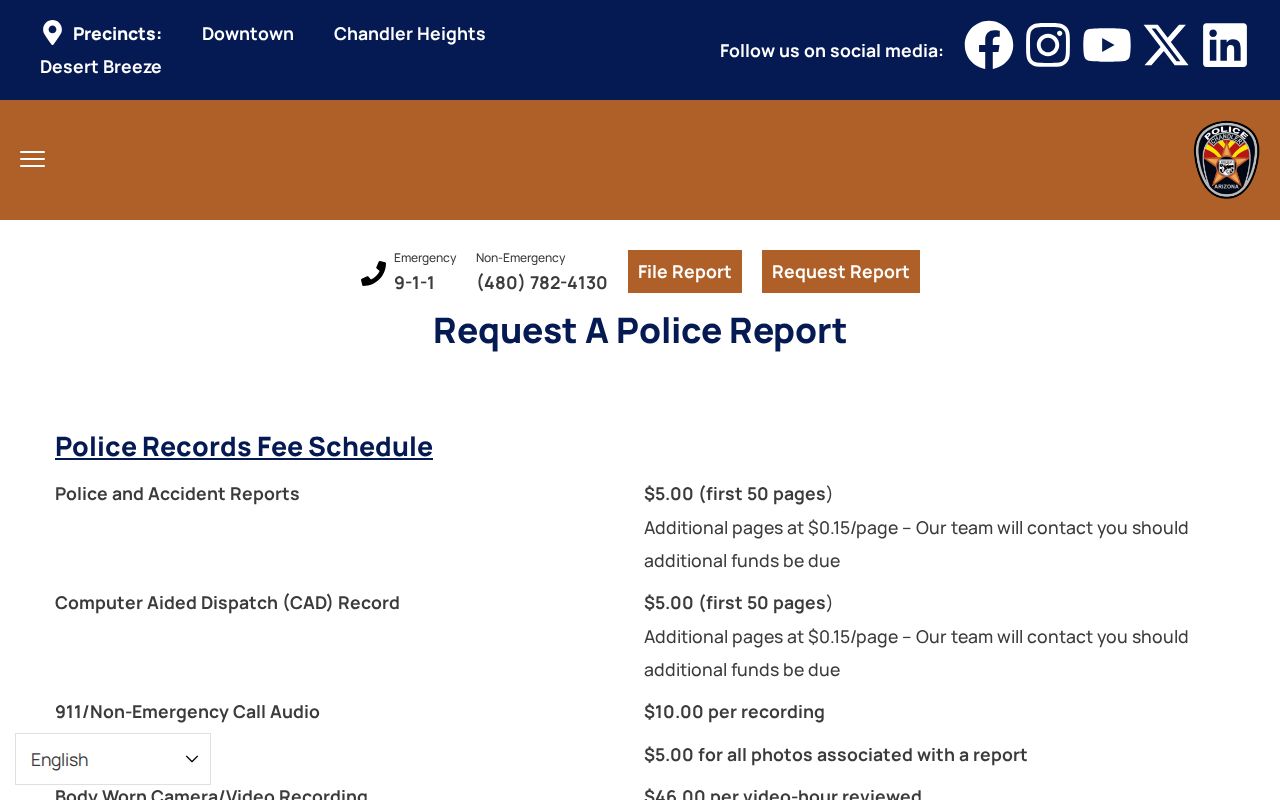
This city process supplies the police layer; MCSO and the courts still supply custody and prosecution records.
Recent Maricopa County Bookings
The MCSO Daily Jail Population Report is the main researched source for recent Maricopa County bookings. Its alpha list displays booking number, name, race, sex, date of birth, status, age, booking date, arrival date, expected release date, and charges. No private names from that roster are republished here. The list is useful because a jail admission can appear before a prosecutor files a public court case.
Roster limits matter. The report describes current custody and booking data, not a person's full Maricopa County arrest history. Release can cause an entry to disappear. A case can also be dismissed, end in a not-guilty verdict, or proceed under charges different from the booking allegations. Check the proper court before drawing any conclusion from a booking. For the filed docket and final result, use the Maricopa County Court Case Lookup.
Custody is not guilt. The MCSO list shows jail intake and status. It does not establish that a charge was filed or proved in court.
Maricopa County ITR Booking Path
Intake, Transfer and Release, known as ITR, is the operational hub for Maricopa County arrest bookings. MCSO describes the facility at 2670 S. 28th Drive in Phoenix as the point for intake, booking, releases, self-surrenders, transport, and four courtrooms. It processes about 100,000 bookings and 90,000 releases per year. Officers create booking identifiers and fingerprints there, while medical and mental-health screening and classification help determine whether a person stays at ITR, enters short-term holding, or moves to another MCSO jail.
The process can be read as: Arresting agency report → ITR intake and fingerprinting → MCSO custody record → initial appearance or release → court case if charges are filed. A later state-prison transfer moves the custody search to ADCRR. The arresting agency still holds its report after each of these moves.
An official MCSO source used in the Maricopa County arrest research shows the separate inmate-account channel.
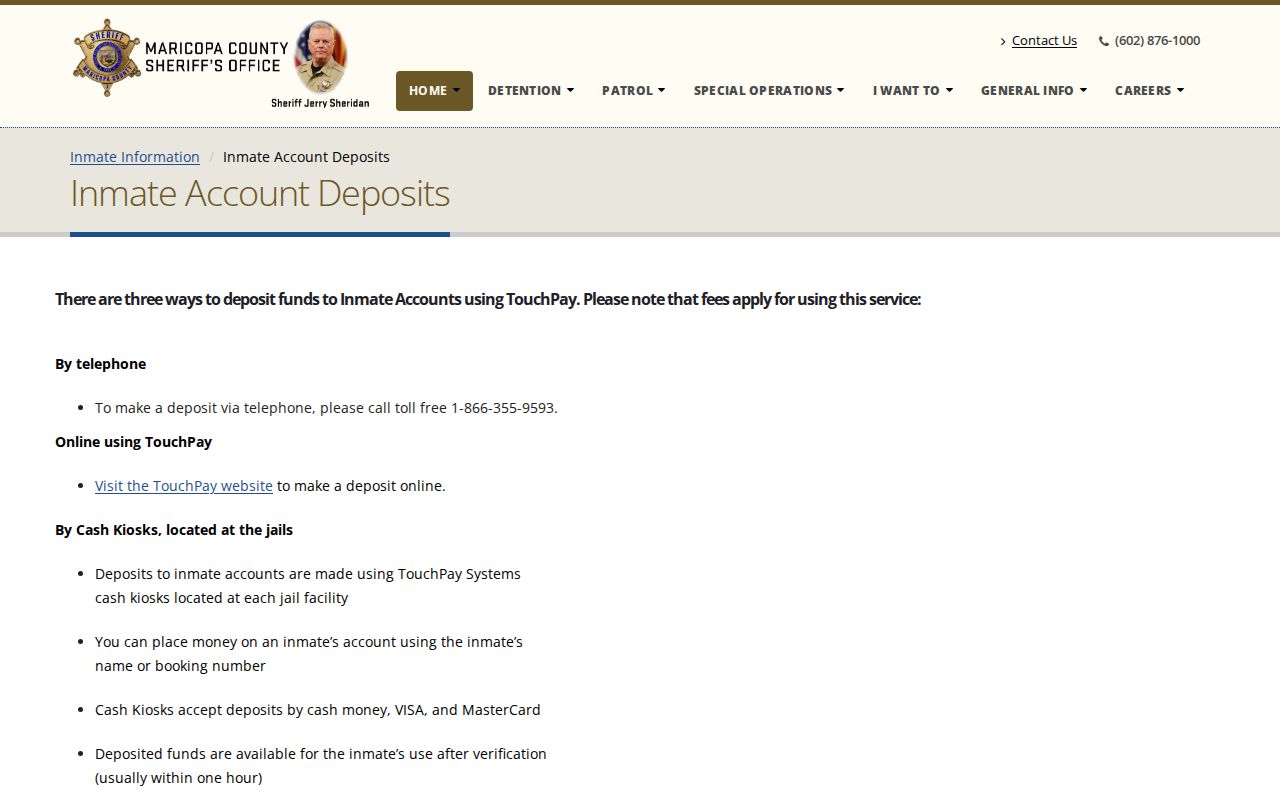
The account page is not an arrest search, but it reinforces that MCSO services rely on the inmate name or booking number created at intake.
Maricopa County Arrest Reporting to DPS
Eligible Maricopa County arrests can become part of the Arizona DPS Central State Repository through fingerprint reporting. A.R.S. § 41-1750 calls for ten-print fingerprints and a process control number for listed offenses, followed by arrest and disposition information. The resulting repository history may include arrests, detentions, formal charges, dispositions, sentences, supervision, and release. It is broader than one police report or one court docket.
Access is also more limited. Arizona DPS does not offer the public a general name-based rap-sheet search. A subject may inspect their own record for accuracy and completeness through the DPS Public Services Portal or by contacting the Central State Repository Section. Fingerprints help tie the review to the right person. Public police blotters, judicial files, and the MCSO roster remain separate channels even when related data later reaches DPS.
Arrest Records vs Conviction Records
An arrest shows that an agency took a person into custody based on probable cause or a warrant. A conviction requires a guilty plea or finding in court. Between those points, a prosecutor may change charges, decline to file, or dismiss a count. A judge or jury may return a not-guilty result. Compare the original Maricopa County arrest record with the court disposition before treating an allegation as a resolved case.
| Point | Arrest Record | Conviction Record |
|---|---|---|
| Created by | Arresting agency and, after intake, MCSO | The court after a plea or finding of guilt |
| What it proves | An arrest or booking was recorded | A charge ended in a conviction |
| Main source | Police records unit and MCSO custody records | Superior, justice, or municipal court file |
| Charges shown | Allegations at arrest or booking | Counts resolved by guilty plea or verdict |
| Possible end | Release, no filing, dismissal, or later case | Sentence, appeal, set-aside notation, or qualifying sealing |
Note: A Maricopa County arrest is not proof of guilt, and many bookings do not end in a conviction.